Solutions
Electronic security
Perimeter, access and video, on one timeline of what happened.
What it solves
When there is an incident, the reconstruction means stitching three exports with three different clocks. The half hour spent lining up timestamps is the half hour that mattered.
Video wall
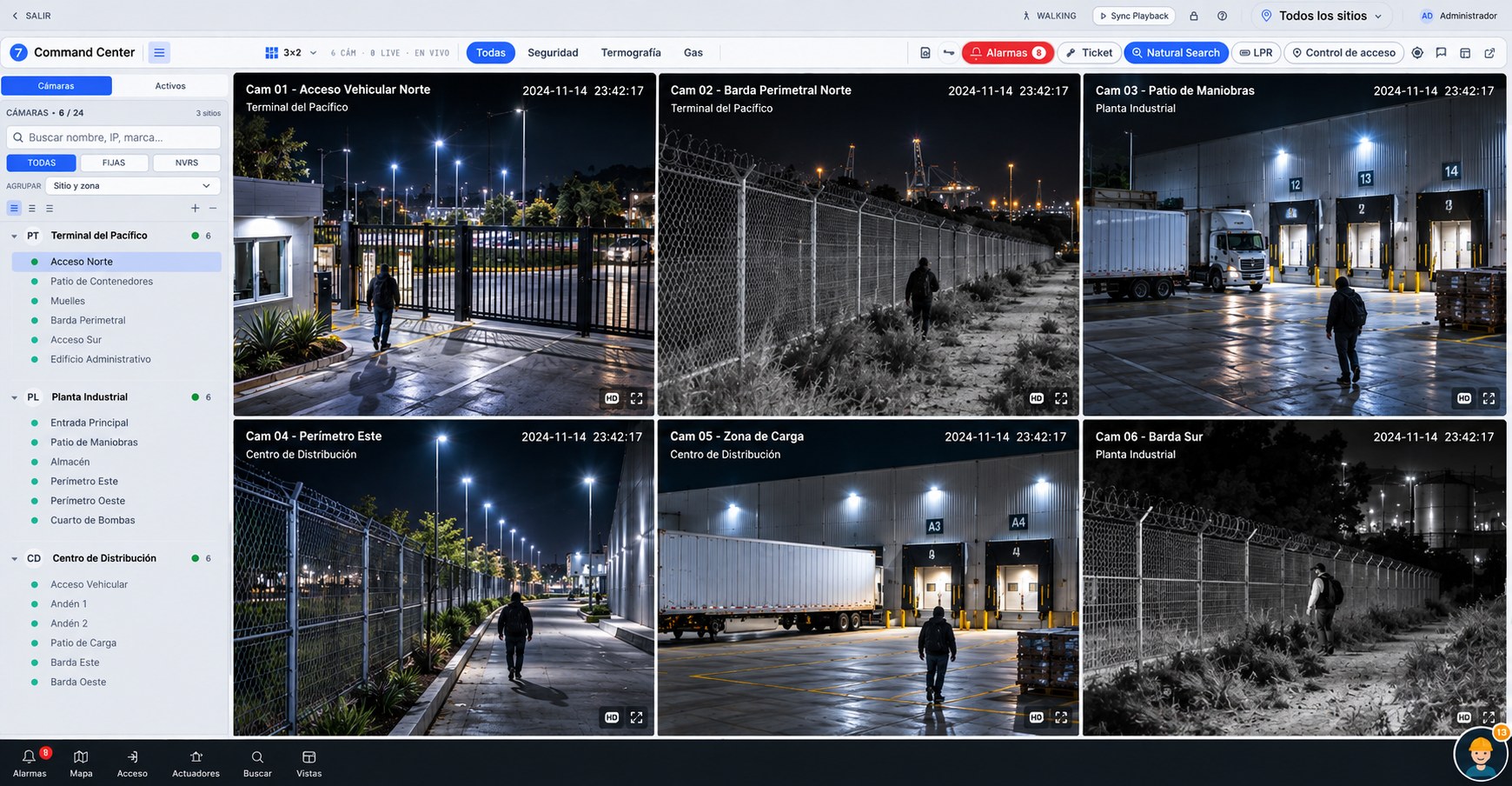
Six cameras from three sites, on one clock
All six views carry the same instant, and when you scrub back they scrub back together. That is exactly what three exports from three recorders cannot do: the half hour spent lining up clocks is the half hour that mattered. The tree on the left groups by site and zone, so a plant's perimeter is assembled in two clicks and saved as a view.
The interface comes from the running system. The camera scenes are drawn: they are not from any plant or any customer.
What gets measured here
Every signal, with the standard behind it
250 px/m
Identify · ~40 px of face · biometric ≈ 500
Calidad de imagen por tarea
Detect, observe, recognise or identify each demand different pixels per metre. The standard sets how many, and that decides where each camera goes.
IEC 62676-4 · DORIOff
Face recognition ships disabled · retention with a deadline and auditable deletion
Datos personales en video
Retention with a term, a reason for access and auditable deletion. The camera records; the system answers why it was kept and who saw it.
GDPR · UE 2016/679Seguridad y salud en el trabajo
Incidents with potential injury are logged with their evidence and feed the management system, not a separate spreadsheet.
ISO 45001
The full catalogue is 311 standards across fourteen domains, and it lives inside the platform — next to the field where the number goes — not in an appendix to the manual.
Radar cues the camera
A radar gives the azimuth of something moving and the PTZ swings there by itself. Without it, the operator searches by hand at the moment they have least time.