The platform
One system to see, measure, predict and act in time.
Video, radiometric thermography, gas, access control, sensors and asset management on the same database and the same alarm engine. Not a suite of integrated products: one product.
What it is
Industrial power, simple operation
Industry has two families of tools and neither solves the whole problem. Heavy industrial platforms model everything and take three weeks of consulting to light up a screen. Modern security platforms are usable on day one, but they only know cameras — and only their own brand. Septem was built in between, deliberately.
Integral
Video, temperature, gas, access and the asset are one system. A thermal alarm opens a work order on the same equipment the camera is watching, with no bridge and no export.
Multi-brand
ONVIF as the base and purpose-built drivers where they're needed. There's no closed catalog forcing you to replace the installed fleet before you can start.
It measures, it doesn't guess
Degrees and ppm come from radiometric hardware and from the detector, not from a model estimating them off the image. That's the difference between a reading and an opinion.
Predicts to prevent
The goal isn't to record the failure in good video: it's to say how many days are left before the hot spot crosses the threshold, while the outage can still be scheduled.
The operator's screen
What the person on shift sees
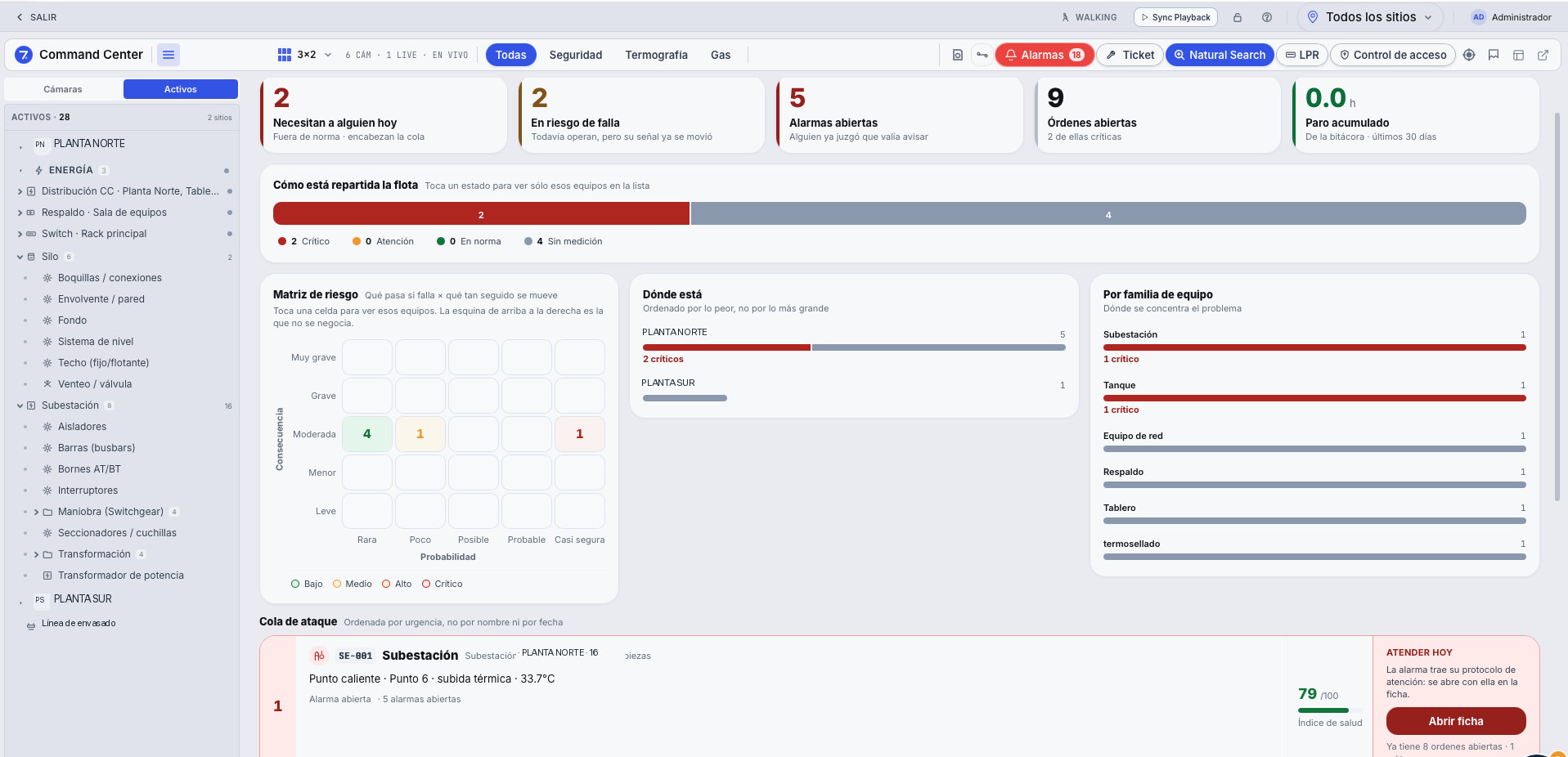
The screen does not open with a grid of equipment: it opens with the ones that need somebody today. Below, the risk matrix — what happens if it fails against how often it moves — where the problem concentrates, and a queue ordered by urgency rather than by name or by date.
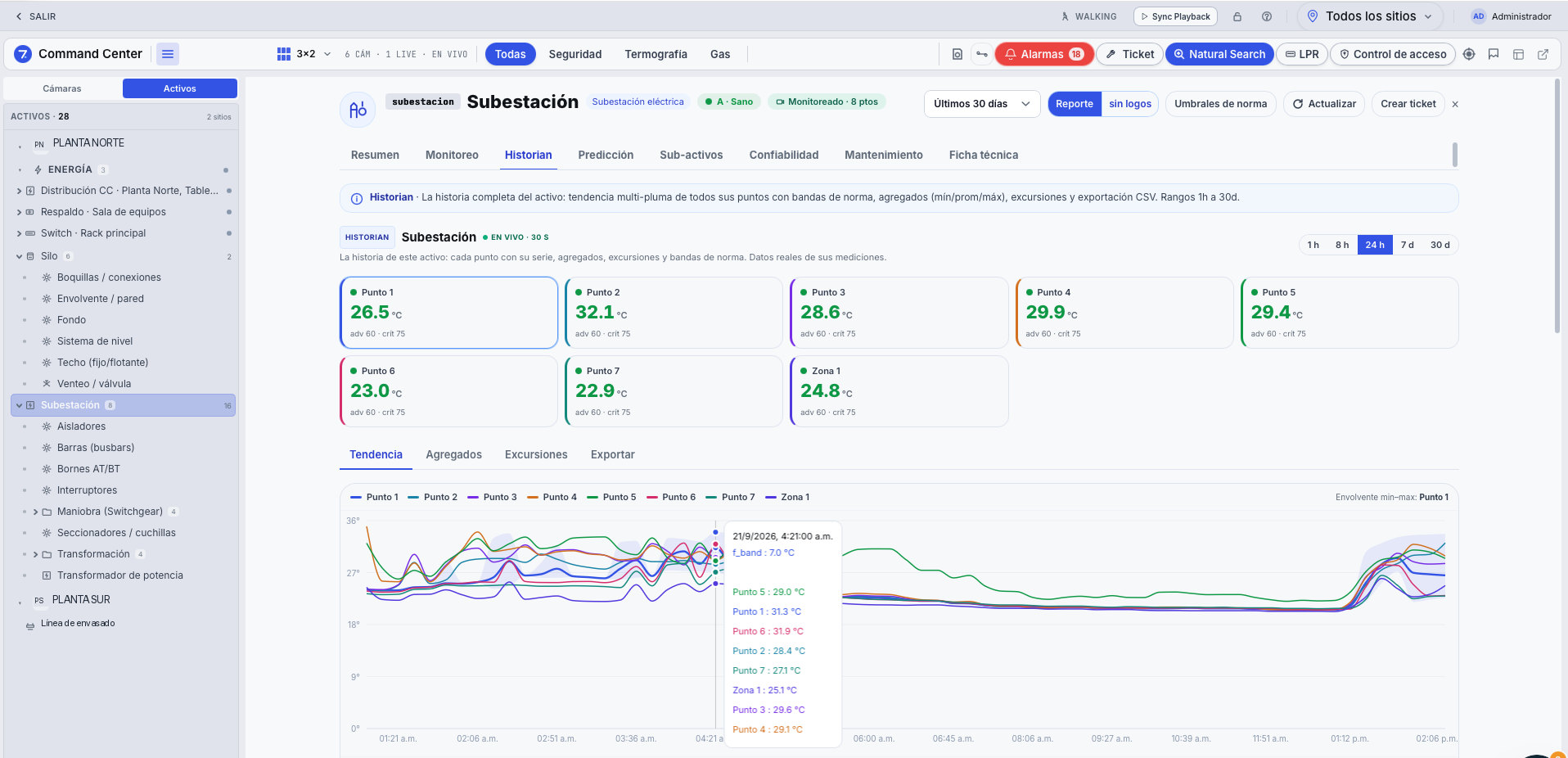
And for each asset, its full history. Every measurement point with its series, its standard bands, its aggregates and its excursions, up to thirty days back and exportable. Without it, today's number does not say whether it is fine or has been climbing for three weeks.
The modules
All on the same foundation
They're licensed separately because not every plant needs everything, but they share the asset, the site, the user, the alarm engine and the history. Turning one on isn't installing another product.
Video
Continuous and event recording, video wall, forensic search and AI analytics at the edge.
Thermography
True radiometric readings per measurement point, with standards-based bands and a thermal health index.
Gas
Optical leak detection and point detectors, with catalog exposure limits and their source.
Access control
Doors, groups, schedules, holidays and readers — facial included — with video evidence for every entry.
Sensors and energy
SNMP, Modbus and MQTT: power supplies, PDUs, tanks and process variables in the same history.
Assets and work orders
Equipment record, health, condition-based maintenance and work-order closure verified by the sensor.
We never charge per user. The license is measured per monitored unit — camera, asset, gas point — so adding people to the operation costs nothing more.
The admin console
And who can change a threshold
Device onboarding, asset templates, alarm rules, response protocols, users and permissions. Separate from the operator screen on purpose: whoever is working a shift shouldn't be able to change a threshold by accident. The threshold comes down already set; nothing goes back up from the shift.
What comes out of it
The report writes itself, and it carries the badge of whoever receives it
What a management team asks for every month is not a screen: it is a document. Here the system composes it from what it measured — with nobody exporting anything to a spreadsheet — and sends it on the date it is told.
Set up once
Daily, weekly or monthly, to the addresses you choose. On the day, it is already composed and sent, not waiting for someone to remember.
The logo is the recipient's
The header carries the customer's mark and, where there is an integrator involved, theirs too. Septem's goes in the footer: the document belongs to whoever runs the plant, not to us.
Every finding with its standard and its action
Not a list of temperatures. Each critical point comes with the class it falls in, what it was compared against, and what to do — in that order.
And what is coming, not only what happened
Monitoring due dates, open repairs and the next thirty days. A report that only looks backwards changes no decision.

Isolation and security
One customer's data doesn't mix with another's
On a multi-customer platform, isolation can't depend on every query remembering its filter. Here it lives in the database: the row carries its owner and the engine refuses to hand it to another session, even when the query gets it wrong.
- 196
- tables isolated in the database
- 1,377
- API routes
- 4
- layers of isolation
of 344 · the ones holding customer data
1,685 operations · measured on the live system
session, request, query and row
- 01
At the row
Row-level security by organization. The session's role cannot read another organization's row, not even by writing the SQL by hand.
- 02
At the request
Every request pins its organization when the transaction opens and releases it when it closes. No state survives between two requests.
- 03
At the permission
A capability matrix per role — operator, supervisor, administrator — and mandatory two-factor for administrative accounts.
- 04
At the edge
Plant equipment ingests with its own credential, and that credential decides the organization. It never travels in the message body.
Continuity
What keeps working when something fails
This is the question that really separates an industrial platform from a pretty dashboard. The answer is designed, not improvised.
- 01
Devices
Cameras, thermal cameras, detectors, readers and sensors. From any manufacturer that speaks an open protocol.
If one drops, the rest carry on.
- 02
Edge
Recording, AI analytics and radiometric reading, inside the plant.
With no internet: it records, detects and alarms just the same.
- 03
Server
The platform: assets, alarms, protocols, work orders and reports.
The edge keeps recording and syncs on return.
- 04
Cloud
Multi-site, fleet and administration. Optional: the install can be 100% local.
The plant never notices.
Without internet
The edge records, detects, measures and raises alarms just the same. When the link returns, it syncs what it missed. The plant doesn't depend on the cloud to protect itself.
Services that recover on their own
A watchdog checks every 90 seconds and brings back whatever went down. A dead service nobody restarts is a blind camera nobody sees.
One dead camera doesn't drag the rest
Equipment that stops answering goes into cooldown instead of burning the thread retrying. It was a real problem: switched off, one camera was asking for four hundred and fifty attempts an hour.
Evidence isn't deleted
Retiring a camera removes the record and keeps the video. Deleting it is a separate action, asks for a password and a reason, and lands in the log.
Operate
What it takes to hold it up for a year
The features nobody asks for in a demo, and without which the system starts lying by the third month.
- 01
Asset tree inside the command center
The left panel switches between cameras and ASSETS with a toggle. Under each asset hang its systems and sub-assets — nozzles, terminals, windings, bearings — in a single hierarchy, not a parallel tree that drifts out of sync. The operator navigates by equipment, not by network.
- 02
QoS · the system watches itself
Recording coverage per camera, hour by hour, against what it should have recorded; per-device diagnostics with the reason when something doesn't answer; and state per plane — cloud, edge and cameras — separately. A recorder that's been dead three hours stops showing green.
- 03
Recovery without a ticket
Whatever went down is retried from the same screen. A watchdog checks every 90 seconds and brings back what it can on its own; what it can't is one click away instead of one phone call.
- 04
A downed camera is actually detected
Registered isn't the same as alive. State comes from the last frame received, not from the record existing — which is how a whole site can spend three hours dark and green.
Open
Thirteen drivers and no mandatory proprietary SDK
The installed fleet doesn't get thrown away. Anything speaking an open protocol comes in the front door, and for what doesn't, there's a purpose-built driver — certified against the real device, not against its datasheet.
Every driver passes a functional conformance bench before it ships. It states what the device can actually do, not what the brochure promises.
CompatibilityONVIF as the base for video, PTZ and events.
Purpose-built drivers for thermal cameras from several brands, gas ones included.
SNMP v1, v2c and v3 for power supplies, PDUs and energy equipment.
Modbus and MQTT for process sensors and actuators.
Output to ERP, TOS and SCADA through a declarative translator, with no new code per customer.