Tank and silo level
Knowing how much product is left inside a tank or a silo by looking at it with a thermal camera — without opening it, climbing it or installing anything inside.
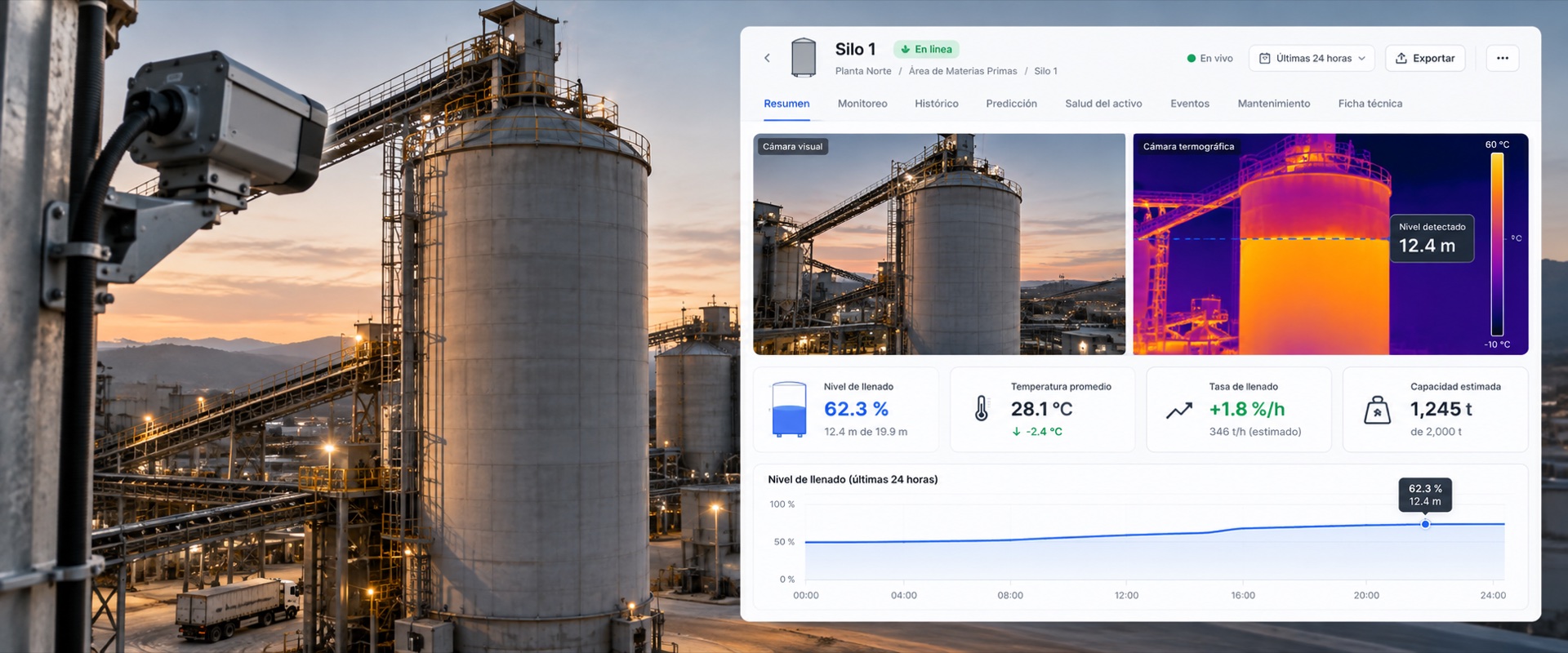
No contact
Nothing enters the vessel or touches the product. The thermal line marks the surface from outside.
The profile is taken by median
Not by average. That is what keeps a ladder, a weld or a stain from moving the reading.
Two gates before publishing
It needs contrast between the two zones and an edge sharp enough. Without that the system would rather say nothing.
Volume, not height
Litres, tonnes and free capacity from the vessel's real geometry. Percentage of height is not percentage of volume.
Why it matters
Manual gauging means somebody climbs to the roof and opens the hatch. It costs a shift, releases vapours, and it's the manoeuvre where people actually fall. Instruments inside solve that, but the tank has to be emptied to fit and calibrate them, and with solids or foam they foul. The camera looks from outside and never touches the product.
How it works
- 01
The product and the space above it cool and warm at different rates, so the surface shows up as a thermal step. The camera finds it: this is a measurement from radiometric optics, not a model guessing from a picture.
- 02
The profile is taken by median rather than average, which is what keeps a ladder, a weld seam or a rust patch from being mistaken for the product.
- 03
Two gates decide whether there's a reading: enough contrast between the two zones, and a sharp enough edge. If they aren't met, the system says it did NOT measure, and why. It doesn't invent a number to fill the gap.
- 04
The reading is stabilised with a rolling median and a dead band, like a field transmitter: the value doesn't jump with every frame.
- 05
The result is converted into what's actually asked for — litres, tonnes, free capacity — using the vessel's geometry: vertical, horizontal cylinder, sphere or conical bottom. Each geometry has its formula, and it lives in the system, not in somebody's spreadsheet.
In practice
The silo that warns before it runs short
From the fill rate and the free capacity, the system works out when the reorder point will be reached and says so hours ahead. That's the difference between scheduling a truck and stopping the line waiting for one.
Capabilities
- Non-contact · nothing enters the vessel or touches the product
- Vertical, horizontal cylinder, sphere and conical bottom
- Litres, cubic metres, tonnes and free capacity
- Fill or draw rate, with an estimate of when the limit is reached
- Two-click calibration on the image: full and empty
- High and low limit alarms, with the video of the moment
- It says when it could NOT measure, and why
- The same camera can watch the vessel and the area around it
What it does not do yet
- It needs thermal contrast between the product and the space above. A buried, insulated or thermally steady tank may not have it; morning and afternoon solar load is usually enough.
- The camera has to see the vessel wall. A tank out in the open, yes; one indoors and blocked by structure needs to be surveyed.